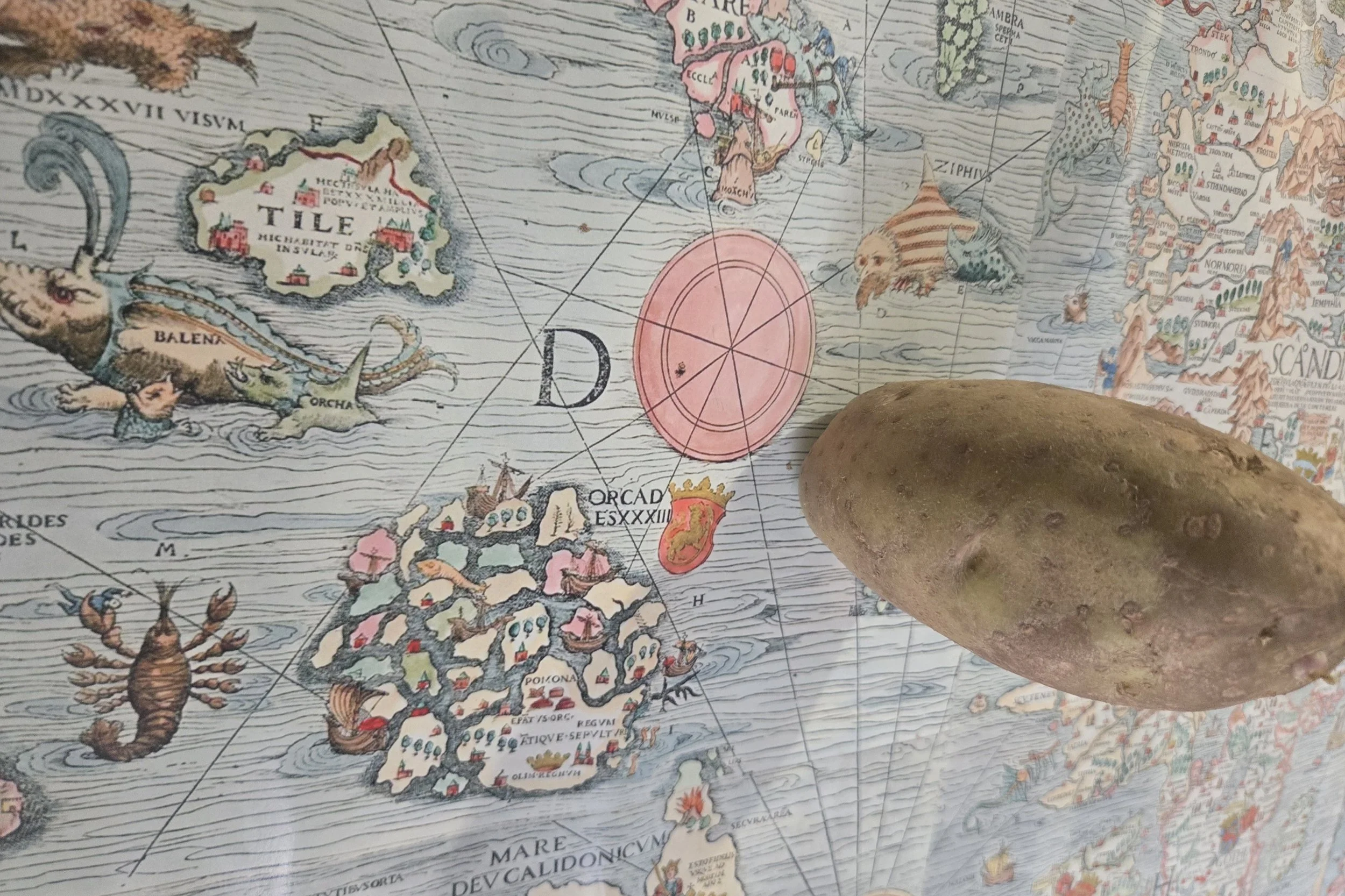
Olaus Magnus, Carta marina, 1539
Be curious. Let’s Explore Together.
I help organizations understand complicated problems, uncover what’s really getting in the way, and make better decisions about what to do next.
I’m curious about overlooked opportunities, possibilities, and connections between people, places, information, and the things we build.
How I work
When something is complicated, I take it apart to understand how the pieces fit together: people, places, activities, projects, processes and things.
Once I can see how it works, I start looking for possibilities that weren't obvious at first, and what might make a workable, sustainable solution.
I like building plausible solutions that people can look over, add to, challenge and refine. I work with people as well as systems, building teams around what people are good at, giving them room to contribute in their own ways, and helping them develop the skills to take on more.
A solution isn't really finished if it only works while I'm there. I want to leave people, systems and organizations more capable than I found them, with something that can be maintained, repeated and improved when the same problem comes around again.
Sometimes the most useful possibility is in a connection that nobody has made yet.
I've done this in some very strange places
Government information management
I worked with government information systems on a very large scale, including immigration and settlement records, assets and resources, archival records, and tens of thousands of architectural drawings. The work meant understanding how information was organized, where it came from, who needed it, and how the pieces fit together.
The useful answer was rarely just “find the record.” It was figuring out how to make a complicated information system understandable and usable by the people who had to work with it.
Communications and information
Communications has been part of my work from the beginning: campaigns and community outreach, multilingual communications, media relations, parliamentary and ministerial briefing material, publications, training materials, corporate communications, and websites.
Often the problem wasn't the message. It was the system around the message. In one case, a database's sort-and-filter logic was sending the wrong language material to the wrong households. I rebuilt the structure, added the distinctions and exceptions that were actually needed, and tested the results before putting it back into use.
The problem wasn't the mailing. It was the information system that produced the mailing.
Immigration and settlement
Immigration and settlement work put me at the intersection of people, language, information, and practical delivery. I worked with communities whose working languages were not necessarily English or French, developing ways to identify who needed what information and communicate with them in ways that actually reached them.
The work taught me that good communication is not simply producing the right message. It is understanding who needs it, what they need from it, and how to get it to them.
Assets and resources
I've worked with physical assets and resources where the challenge was not simply knowing what existed, but understanding how those resources could be used together. That meant looking across operations, transportation, facilities, people, equipment, and the constraints imposed by distance, timing, cost, and availability.
Sometimes the useful question was simply: What do we already have, what else is available, and what could we do differently?
That way of looking at resources has followed me into increasingly complicated logistics and transportation work.
ADR and organizational reconstruction
At the ADR Institute of Canada, I inherited a collection of records and responsibilities that had become tangled across several related organizations. Files, governance, memberships, charitable status, and administrative responsibilities did not always line up with the organizations they were supposed to represent.
Rather than assuming the problem was simply missing paperwork, I pulled the pieces apart to understand what actually existed, what was still viable, and what needed to be reconstructed. I worked with the board and executive director to develop a workable path, reconstitute governance where needed, and put the pieces back together in a form the organization could manage.
The solution wasn't mine to impose. My job was to understand the situation, develop plausible options, test them with the people responsible, and help put the agreed solution into practice.
ADR Institute of Canada Journal
As editor of the Canadian Arbitration and Mediation Journal from 2002 through 2004, I was responsible for four issues in each annual cycle. The 2002, 2003 and 2004 editions are available through the Institute's journal archive.
View the 2002–2004 CAM journal archives →
Lunenburg County Socials
Lunenburg County Socials
Lunenburg County Socials began with a simple idea: be curious and explore together.
People don't always arrive knowing exactly what they want to see or do. Sometimes they have a particular interest, sometimes only a question, and sometimes they simply want to discover what is around them. I listen for those interests and connect them with places, history, food, nature, people, stories, and whatever else helps make the exploration meaningful.
One visitor came for a pierogi dinner. What we actually explored was Lunenburg County: its landscape, communities, churches and cemeteries, local history, migration, food, and the people who make the place what it is.
The subject changes. The way I work doesn't.
Explore
There is more to explore here.
See some of the things I've created, written, reconstructed, hosted, or investigated. Some are projects, some are writing, some are experiences, and some are simply things I found interesting enough to follow.
This isn't a résumé. It's some of the evidence behind the way I work.
Explore what I've been up to →
Connect with Rob
Connect
Sometimes the useful thing is simply another person to talk to.
I've spent a lot of time working across organizations, communities, projects, and disciplines. Sometimes the useful contribution is a solution. Sometimes it's a question, a connection, or another way of looking at something.
Something doesn't fit?
Looking for options?
Bring me the situation. We can look at what might be possible, what resources are already available, and what could actually work.
Banner image: Carta Marina, 1539, Olaus Magnus.